Occupational Safety and Health
Basic Views
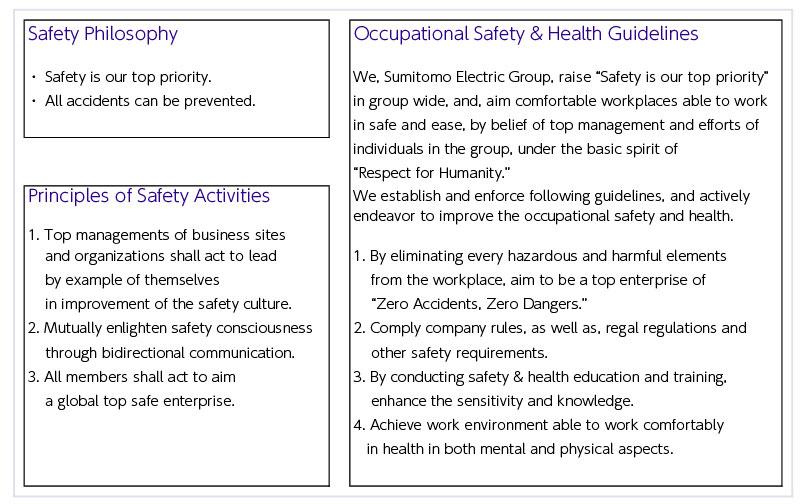
The Group positions safety as one of the most important management issues. Aiming to be a world’s safest company, the entire Group is making a concerted effort in performing safety and health activities. Recognizing that ensuring the safety and health of employees is essential for our continued existence as a corporate group and is also part of our corporate social responsibility, we have established the Sumitomo Electric Group’s Safety Philosophy, Principles of Safety Activities, and Occupational Safety and Health Guidelines. Guided by these, we are making efforts to eliminate occupational accidents, including promoting activities by our safety and health organization, such as equipment safety measures, and establishing a safety and health education system.

Promotion System for Safety and Health
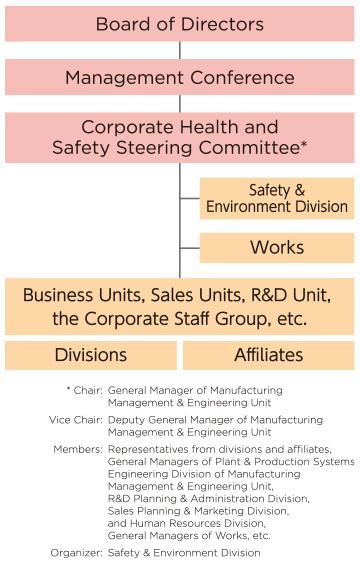
The Corporate Health and Safety Steering Committee, which comprises representatives from all the divisions and affiliates of the Company, sets policies and targets for improving occupational safety and health activities throughout the Group and reducing occupational accidents and injuries. After deliberation, the committee develops proposals on safety and health measures and activities. The Management Conference of the Company, headed by the President, approves these proposals. These proposals are also reported to the Board of Directors.
Promoting occupational safety and health management systems and strengthening risk assessment implementation
To achieve perfect occupational safety, it is essential to eliminate risk factors, and thus it is important to effectively operate an occupational safety and health management system and strengthen risk assessments (identifying and evaluating hazard sources at workplaces).
An occupational safety and health management system is a system for taking measures before an accident occurs by identifying and evaluating hazard sources and harmful elements latent in field work. The Ministry of Health, Labour and Welfare recommends its introduction as part of activities to eliminate occupational accidents, and activities to promote this system are carried out internationally.
Based on the Ministry of Health, Labour and Welfare’s Guidelines on Occupational Safety and Health Management Systems (OSHMS), the Group has established the stricter Sumitomo Electric Global Standards (GS) for the entire Group. Additionally, at our overseas sites, we carry out safety and health management according to standards defined in the laws and regulations of each country or Sumitomo Electric’s GS, whichever are stricter. Based on these, we are actively working to carry out risk assessments thereby reducing risk levels systematically and continuously.
Targets
Targets to achieve the Mid-term Management Plan 2025
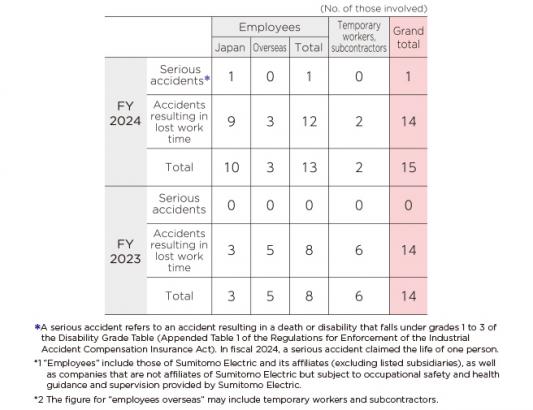
Zero serious accidents
*Serious accident: An accident resulting in a death or disability that falls under grades 1 to 3 of the Disability Grade Table (Appended Table 1 of the Regulations for Enforcement of the Industrial Accident Compensation Insurance Act)
Initiatives for Safety and Health
To achieve our Mid-term Management Plan 2025, we have continued to conduct our safety activities with three pillars: 1. Fostering a safety culture, 2. Safety measures in facilities, and 3. Developing human capital with high safety awareness.
Fostering a safety culture
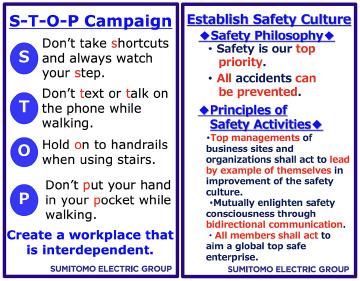
Based on the Safety Philosophy and the Principles of Safety Activities, Sumitomo Electric and Group companies both in Japan and overseas are mainly conducting the following activities to foster a safety culture:
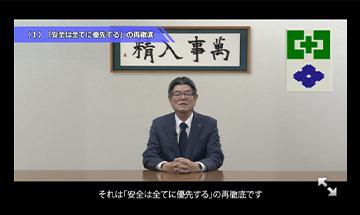
1) Once every six months, the President himself issues a Message from the President and COO to all employees, temporary workers, etc., via internal broadcasts, global newsletters, and other media to advocate clear safety policies. In addition, we hold a Corporate Safety Conference twice a year to share information about safety achievements, activities of each division, and priority initiatives and spread good practices among them, in order to ensure thorough awareness that safety is our top priority, an item of our Safety Philosophy throughout the Group. To promote our efforts to foster a safety culture, we created safety awareness cards (available in 12 languages, including Japanese, English, and Chinese) and distributed them to all Group employees to ensure the permeation of the S-T-O-P Accident Campaign* and other initiatives.
2) Executives such as division general managers and the presidents of affiliates declare action targets as “safety actions of top management” and demonstrate how to perform those actions to drive the safety mindset of employees. At the end of each fiscal year, this initiative is reviewed with feedback sought from employees, and the review results are incorporated in the next fiscal year’s activities.
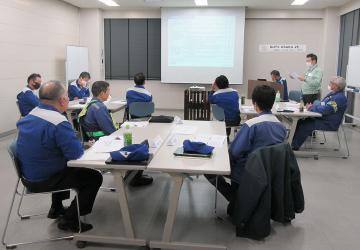
3) We have increased opportunities for dialogue between patrollers and workers during regular safety patrols. The patrollers directly express their gratitude to the workers for complying with safety rules and share their findings and insights regarding risks at the workplaces, thereby ensuring full awareness of safety on both sides. This kind of dialogue sometimes reminds workers of recent problems, no matter how minor they are, and allows them to share with the patrollers information about risks that cannot be confirmed immediately, leading to improvement measures being adopted. Additionally, to raise the quality of dialogue, we train safety experts in each division, who play a key role in our efforts to improve the dialogue skills of managers at each workplace.
4) We conduct a periodical safety awareness survey to quantify each division’s tendency. Making the most of good practices in the Group, we promote improvement activities attuned to each division.
5) Furthermore, as an overseas initiative to promote safety activities in line with the laws, regulations, and characteristics of each region, we have established an EHS Committee* in the Americas and Safety Working Groups in Greater China and Southeast Asia. These organizations hold regular meetings as opportunities for exchange of information about laws and regulations, the status of each company’s initiatives, etc. between the Group companies.
*S-T-O-P Accident Campaign: This slogan represents basic rules to be followed while walking. S: Do not take a short cut and watch your step; T: Do not text or talk on the phone while walking; O: Hold on to the handrails when using stairs; and P: Do not put your hands in your pocket while walking
*EHS Committee: A committee that tackles issues related to the environment, occupational health, and safety, and promotes activities aimed at creating a safer working environment
Safety measures in facilities
– Protecting people from dangers through hardware-related measures
Switch-off and zero residual energy activities
Since 2019, we have identified a cumulative total of 2,400 routine operations that involve direct contact with or approach to rotating or moving parts of equipment in operation at all sites in Japan and overseas. By fiscal 2024, we have completed implementing all hardware-related safety measures.
We also implemented measures to visualize residual energy in switched-off equipment, such as residual pressure and inertia, so that workers can monitor it with lamps, meters, or other instruments.
Meanwhile, we have not yet completely eliminated accidents caused by direct contact with or approach to rotating or moving parts of equipment in operation during non-routine operations, such as responses to defects in products being processed or recovery from equipment malfunctions. To eradicate such accidents, in addition to safety measures in facilities, we are implementing the initiatives to completely eliminate facility trouble itself and ensure the safety of troubleshooting work with the aim of making high-risk non-routine operations unnecessary.
Preventing serious accidents involving forklifts
By 2023, we have completed implementing the Level-4 measure to separate workers and forklifts (separation with fixed fences and temporal separation) at all sites in Japan and overseas.
Every time a situational change, such as the need to introduce a new process or a change in the work procedure, makes it likely that workers will be closer to forklifts or every time a potential risk is identified during daily work, we devise and implement improvement measures, thereby maintaining our level of separation between workers and forklifts at Level 4.
Developing human capital with high safety awareness
– “Protect your life by yourself”
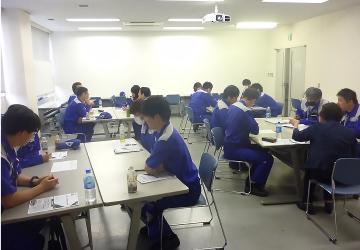
An analysis of accidents at our sites shows that the number of accidents caused by facility-related factors is decreasing, but the number of accidents due to human error or management systems remains unchanged. To eliminate accidents, it is necessary to improve employees’ attitude toward safety, thereby suppressing unsafe actions. In fiscal 2017, we added a course titled “Developing Human Capital with High Safety Awareness” to our company-wide training program and continue to provide safety education with the following focus. We also implement a wide variety of safety awareness-raising measures, including providing position-based safety training for new and other employees.
-
Providing trainees with the opportunity to listen to those affected by accidents (to learn directly about their remorse, hard feelings, and physical and emotional pain)
-
Disaster simulation CG videos + discussions and presentations (aimed at allowing trainees to consider the causes of the accidents and how they could have been prevented)
-
Repetitive safety training to be provide periodically
Group Global Safety Assessment
Under the Industrial Safety and Health Law, we must manage appropriate working environments for dangerous or harmful operations, provide legally required education, take equipment safety measures. To check that domestic affiliates appropriately fulfill these requirements, and to check the progress of their voluntary management activities, we are rolling out Group Global Safety Diagnosis in manufacturing sectors and affiliates in Japan and overseas.
In the Group Global Safety Diagnosis, in addition to checking various management activities, the auditors tour the plants and give instructions in order to ensure that segments with potential risks are identified and appropriate measures are taken. In particular, the safety measures on equipment are also evaluated in the facilities which involve especially high risks.
We also carry out a point-based evaluation of the system in place when procuring equipment using a checklist, and we identify the strengths and weaknesses of each department and affiliated company that has been inspected, and we provide traceability and support to ensure that appropriate measures are implemented.
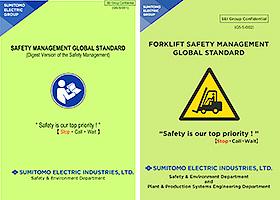
We have established and are operating “SAFETY MANAGEMENT GLOBAL STANDARD” and “FORKLIFT SAFETY MANAGEMENT GLOBAL STANDARD,” which are standards to be observed by each section and affiliate of our group to promote unified safety and health management.
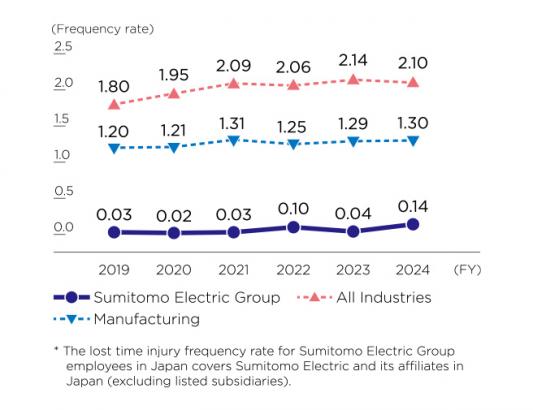
Safety Performance