Risk Management
Basic Policy for Risk Management
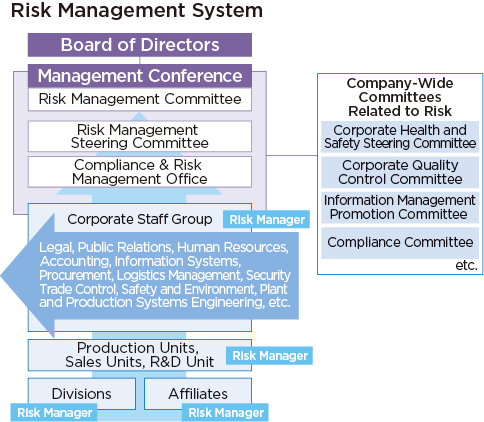
Sumitomo Electric has established the Risk Management Committee, which is chaired by the President, and promotes the measures that mitigate various risks associated with our business activities such as risks related to safety, disaster, quality and environment. The Risk Management Office serves as the organizer. If risks come to the surface, the crisis management system will be formed promptly and appropriately based on the Basic Policy of Risk Management.
Basic Policy of Risk Management
Risk management is performed based on the significance of the risks determined in consideration of the following issues:
-
Impact on business performance, maintenance of quality and safety
-
Social responsibility to ensure stable supply
-
Maintenance of favorable relations with stakeholders such as employees, customers, suppliers, regional communities and shareholders & investors
-
Continuous compliance with laws and corporate ethics
-
Statements in the Sumitomo Spirit, the Sumitomo Electric Group Corporate Principles and the Sumitomo Electric Group Charter of Corporate Behavior
Risk Management
System
Risk Management
Activities
In accordance with the risk categories below, Sumitomo Electric takes inventory of risks in each unit and affiliate every year and promotes planning and implementation of measures to address significant risks and insufficiently controlled risks. Thus, Sumitomo Electric is following risk management procedures consistently to raise the group-wide risk management level. Risks to our Group are classified as follows in our risk reduction initiatives.
Risk Categories
| Major category | Middle category | Minor category |
|---|---|---|
| Externally generated risk | Non-financial risk |
|
| Financial risk |
|
|
| Internally generated risk | Strategic risk |
|
| Operational risk |
|
 Disaster risk, crime risk
Business Continuity
As part of the Company's risk management efforts, Sumitomo Electric formulates business continuity plans (BCPs) to ensure that our business activities can be continued even in the event of an emergency, such as an earthquake, influenza pandemic and fire, and that we can resume operations at the earliest possible time. Furthermore, we promote business continuity management (BCM) to keep the BCPs updated and provide employees with practical training, thereby preparing them to respond to emergencies.
Emergency Drills
The Sumitomo Electric Group enhances disaster awareness of employees by implementing joint emergency drills twice a year (in the daytime and at night). These are evacuation drills, including confirming the safety of employees and simulating the initial response to emergency situations. Besides these drills, we are expanding the communications equipment available (introducing satellite mobile phones and digital walkie-talkies), reviewing measures to prevent disasters and preparing for situations in which it is difficult for employees to return home.
Information Security
In terms of information security, Sumitomo Electric considers in-house information systems, as well as all information handled by such systems, to be important assets. In October 2003, the Company formulated the Information Security Policy, which declares that the Company will appropriately protect and manage such assets. The Company also strives to continuously improve the information security management system, by establishing security measure standards, including information leakage countermeasures and risk management measures.
Information Security Policy
As a part of the Sumitomo Electric Industries Group, based on its management concept, we aim to be a company that is trusted at all times, and shall make following efforts for information security in order to contribute in making a safe and secure society and environment.
-
Provide excellent products and services with sufficient consideration for information security and respond the customer’s requests
-
Securely protect information received from customers and business partners
-
Securely protect company’s information assets required in manufacturing and office work
-
Strive for constant growth by nourishing information security human resource and conducting continuous employees training
Revised in October 2016
Strengthening of Our Information Security Management System
Moreover, conscious that we have a social responsibility to maintain a high level of security in our products, in October 2016 we launched the “SEI-CSIRT Office” as a means of further strengthening information security management to encompass our products and production equipment.
The company also provides education on information security for all employees every year to ensure observance of the rules. Our conventional efforts to strengthen information security include encryption of the hard drive of laptop computers, supply of safe and secure file transfer service and restriction on data storage in portable electronic media. And our efforts are not limited to administrative operations. To improve security in our production equipment, we limit the devices that can be connected to equipment and have stepped up measures to combat viruses, while in the area of products and services, we are tackling vulnerabilities, developing secure products, and so on.
Security Export Control
To ensure compliance with export regulations aimed at international security, we have established internal export control regulations and have created an export control system with a Representative Director as the ultimate authority.
When engaging in exports, we conduct proper screening of each individual business transaction and proceed with export activities only after obtaining the necessary export licenses, including bulk export licenses.
Relevant parties within Sumitomo Electric and Group companies receive position-specific regular training and training for newly appointed personnel, based on the latest case studies, in order to foster awareness and knowledge of security export control among all involved personnel.
Furthermore, we conduct regular internal audits to constantly monitor the appropriateness of our activities and share information across divisions and Group companies through various committees, aiming to reduce security trade risks across the entire Group.
Respect for and Utilization of Intellectual Property Rights
The Group considers the technologies developed through its own R&D activities to be the most important intellectual property (IP) for strengthening its business competitiveness and ensuring continuous growth. While striving to appropriately manage the confidentiality of our proprietary technical know-how and internal data, we are committed to acquiring and utilizing IP rights such as patent and design rights. At the same time, we respect the IP rights and trade secrets of others and ensure they are handled with the utmost care.
As part of the framework to achieve this, we have established regulations regarding the handling of IP and trade secrets. We have also set up an organization within the Intellectual Property Department to provide necessary support to the Group’s business and research divisions, such as invention management, investigations of prior art and other companies’ rights, standardization activities, and business strategy planning and response from an IP legal perspective. Additionally, IP Strategy Meetings consisting of Strategic Intellectual Property Committee members from the business and development divisions, along with members from the intellectual property division, are held monthly or quarterly depending on the division to plan and execute activities, verify progress and results, and make revisions and updates. Furthermore, during the self-inspection of business operations, which is updated each year, each department/division conducts risk assessments for “infringement of the Company’s rights by other companies” and “infringement of other companies’ rights by the Company’s products.” Through these activities, we strive to reduce the Group’s intellectual property risks while also enhancing the value of its intellectual property and creating business opportunities.