Water Resource Management
For basic views, structure, and targets, please refer to Environmental Management.
For performance data for environmental indicators, please refer to the CSR Book (ESG Data).
Initiatives and Results
In recent years, the problem of water resources has emerged as a risk that could have a major impact on business operations, and investors and customers are calling on the Sumitomo Electric Group to address this problem. Water-related issues include not only a shortage of water supply, but also deteriorating water quality, flood damage, stricter government regulations, and relations with surrounding local communities.
The Group is working to identify and address these challenges. In FY2017, we established guidelines for activities to address water risks as follows: “We will form an organization across the Group to have its manufacturing sites around the world understand the current situation regarding water risks, identify issues, and develop action plans to address them.”
In January 2018, we established a Water Risk Working Group, recruiting members from respective Divisions and affiliates, and have put in place a system to promote initiatives. The Water Risk Working Group meets twice a year as a sub-organization of the Resource Conservation & Recycling Subcommittee, one of the expert committees that provides technical support to the Global Environment Promotion Conference. As in FY2023, the priority activities for FY2024 were holding dialogues with operation sites with high water risks, identifying water risk factors and taking measures, as well as developing a long-term vision for water risks.
<Reducing water use (water withdrawal)>
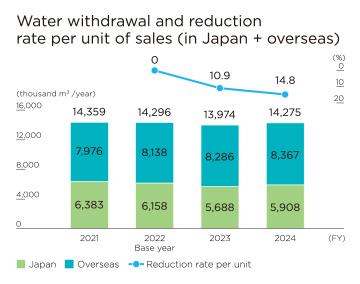
To address water supply shortages, one of the water-related challenges that the Group faces, the Group has been working since FY2008 to achieve the target of reducing water use per unit of sales by 1% annually. We are working to reduce the amount of water withdrawal through reduction activities such as quickly detecting and addressing even the smallest leaks in our sites and considering the reuse of wastewater that has previously been discharged.
Although water use (water withdrawal) in FY2024 was roughly the same as in the base year, the reduction rate per unit of sales stood at 14.8% due to increased sales, exceeding the target of 2%.
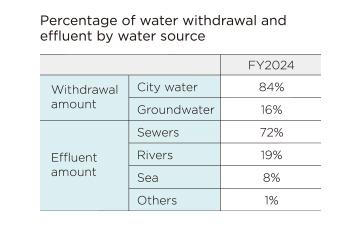
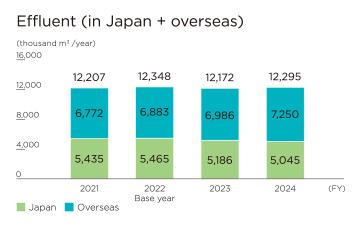
In terms of water withdrawal by water source, 84% came from city water and 16% from groundwater. Regarding the destinations of effluent, 72% went to sewers, 19% to rivers, 8% to the sea, and 1% to other destinations. The percentage of water withdrawal by water source and effluent by destination shown above remained almost unchanged from FY2023.
<Evaluating water risks on a global scale>
Using the water risk assessment tool, Aqueduct*, the Group has evaluated its manufacturing sites in Japan and overseas on 13 risk items, including water volume, water quality, regulations under local laws, and relationships with the surrounding community, on a five-point scale.
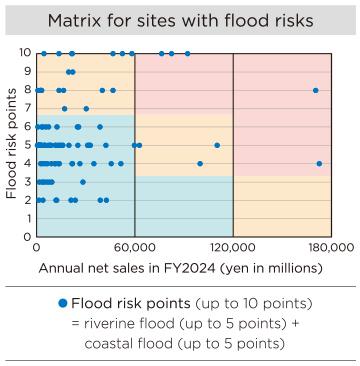
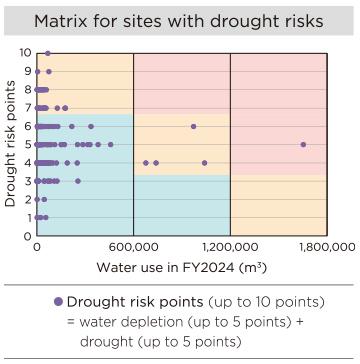
In FY2024, we focused on floods and droughts and identified priority sites with high risks and significant challenges as we did in FY2023. The method involves calculating the flood and drought risk points of each site using Aqueduct’s five-point risk assessment of four categories: riverine flooding, coastal flooding, water depletion, and drought. Each site is then evaluated on both the “probability of water risk occurrence” (flood and drought risk points) and the “magnitude of impact if risk occurs” (net sales or water use), and sites in the red zone of the matrix are designated as those with significant challenges. As a result, the number of sites with significant flooding challenges remained at five, while those with significant drought challenges decreased from two to one due to reduced water use.
Furthermore, as Aqueduct updated its water stress data for the first time in four years since 2019, the number of our sites located in “Extremely High areas” increased from 12 in FY2019 to 34 in FY2024, with the amount of water withdrawal at these locations reaching 1,202 thousand m3 (8% of the total water withdrawal). Some of the above sites have already implemented water conservation and recycling measures, and these efforts will be accelerated in the future.
*Aqueduct: A tool developed by the World Resources Institute (WRI) to assess water risks in various areas around the world. Plotting the location of sites on a world map provides numerical assessment results on a five-point scale.
<Group-wide activities to address water risks>
We investigated the maximum inundation depth of our operation sites in Japan, using the database, My Town Hazard Map, by the Japanese Ministry of Land, Infrastructure, Transport and Tourism and the hazard map of Flood Risk Finder published by MS&AD InterRisk Research & Consulting, Inc. As a result, the number of sites with significant flooding challenges with a maximum inundation depth of 0.5 m or more increased from 15 to 17. We have conducted detailed surveys on these sites in Japan regarding items such as (1) disseminating hazard maps, (2) disaster prevention systems and flood prevention measures, (3) measures to prevent the outflow of hazardous substances, (4) business continuity plans (BCPs), and (5) past damage situations, and have confirmed that these sites are free of issues requiring urgent improvement.
Furthermore, a survey of the maximum flood depth of our overseas sites using the Flood Risk Finder hazard map identified 25 overseas sites with significant flooding challenges with a maximum inundation depth of 0.5 m or more. On sites facing significant flood challenges as well, we plan to conduct the same survey regarding abovementioned items (1) to (5) as on the sites of this kind in Japan.