Waste Reduction and Recycling Promotion
For basic views, structure, and targets, please refer to Environmental Management.
For performance data for environmental indicators, please refer to the CSR Book (ESG Data).
Initiatives and Results
In recent years, the problems of marine plastic waste and resource depletion due to an increasing world population and economic development have attracted attention, making the transition to a recycling-oriented society a challenge that must be tackled. The Sumitomo Electric Group has always considered the issues of resource depletion and the saturation of landfill sites to be important challenges and has therefore been working to reduce the volumes of waste discharged and promote recycling.
Each of our Works and affiliates engages in activities to reduce and recycle waste generated in the course of our business activities. A system is in place in which the status of activities is compiled by each division and reported to and deliberated at the Global Environment Promotion Conference. In addition, we have a framework in place by establishing the Resource Conservation & Recycling Subcommittee under the Global Environment Promotion Conference to discuss how to address group-wide challenges and specific ways to implement measures.
Furthermore, with regard to a circular economy, we launched a cross-functional working group consisting of the R&D Group, Divisions, and other departments in FY2022. Based on the idea of considering recycling and reuse even in the research and development stages, this group is working to create the maximum added value through the reduced use and consumption of new resources and the efficient use of resources.
<Waste reduction>
The Group uses such resources as copper, aluminum, and iron primarily in its electric wire and cable business, as well as a lot of plastic as an insulating material. The majority of waste generated is metal scrap as well as waste acid, waste alkali, waste oil, sludge, etc. from metal surface treatment and processing. Our eorts for waste volume reduction include improving yields, reducing the volume of waste acid, alkali, oil, and other waste, detailed sorting of plastics, etc., and selling waste that can be sold as valuable materials. The Group’s amounts of waste discharged exclude valuable materials.
● Waste discharged and valuable materials
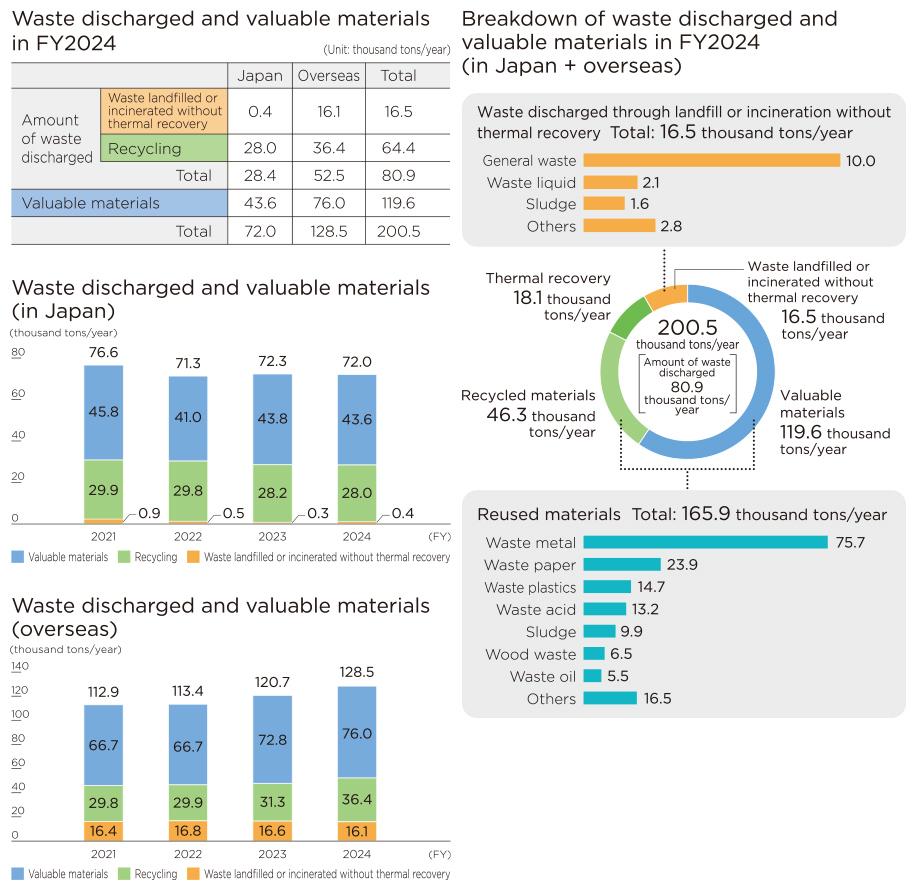
The amounts of waste discharged and valuable materials in FY2024 are shown in the table below. Of the total 200.5 thousand tons of amount of waste discharged and valuable materials, 16.5 thousand tons was waste landfilled or incinerated without thermal recovery and 64.4 thousand tons was recycled, which included 18.1 thousand tons subject to thermal recovery and 46.3 thousand tons to recycled materials. The breakdown of materials reused as recycled materials and valuable materials is shown in the graph below, with waste metal accounting for the majority.
Waste discharged = waste landfilled or incinerated without thermal recovery + recycling
Recycling = thermal recovery + recycled materials

● Waste discharged reduction rate per unit of sales (in Japan + overseas)
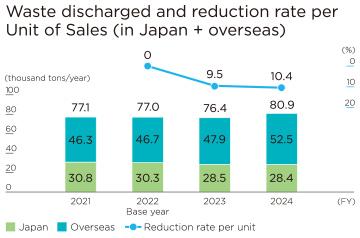
The amount of waste discharged in FY2024 increased to 80.9 thousand tons from 77.0 thousand tons in the base year (FY2022) due to increased sales. However, waste discharged per unit of sales reduced by 10.4% from FY2022. Although there was an impact from decreased production volumes in Japan, the reduction rate showed an upward trend due to factors such as an increase in waste acid, waste alkali, etc. particularly because of increased production and quality improvement measures, more new production sites, and other factors overseas.
<Recycling promotion>
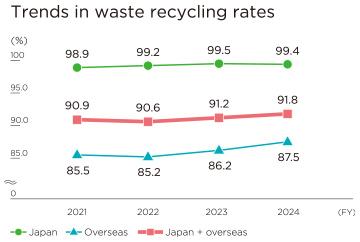
The waste recycling rate is the percentage of the amount of waste discharged and valuable materials that were not waste landfilled or incinerated without thermal recovery.
● Improving waste recycling rate
The waste recycling rate for FY2024, both in Japan and overseas, was 91.8%, falling short of the target of 93%. As shown in the figure above, the waste recycling rate is over 99% in Japan, but remains 87.5% overseas because some countries and regions do not have appropriate waste recycling methods in place.
We regard studying recycling methods that are suited to the circumstances of respective countries as a challenge and will continue to work to improve our recycling rate. In FY2024, the rate improved slightly due to the progress in the development of recycling facilities in Vietnam and China and the outsourcing of waste disposal to recycling companies at each operation site.
We will improve recycling rates by sharing with Group companies information regarding the sites with advanced recycling so as to promote better recycling rates, ensuring waste separation in each region, and strengthening our search for recycling companies.
Waste recycling rate = (recycling + valuable materials) / (amount of waste discharged + valuable materials) x 100