Quality and Customer Satisfaction Improvements
Basic Views
The Sumitomo Electric Group embraces the fundamental principle of providing safe, reliable, and high-quality products to customers in a stable manner based on customer-oriented and quality-oriented policies. To continue to achieve this, the Group works to strengthen its underlying manufacturing competence and continuously makes steady efforts to systematize daily duties as a mechanism, carry them out soundly, and further improve the mechanism.
Structure
Structure of Quality Management
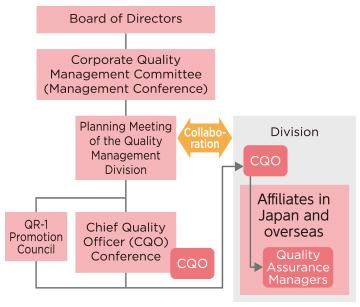
Matters relating to quality in the Group are discussed and decided upon by the Corporate Quality Management Committee (Management Conference). The resolutions are discussed at the Chief Quality Ocer (CQO*) Conference, organized by the Quality Management Division, and the QR-1 Promotion Council, which promotes the QR-1 Campaign, a group-wide quality improvement activity, before being disseminated to divisions and affiliates in Japan and overseas through the CQOs. In collaboration with the CQO of each division, we promote the strengthening of quality-related governance, the development of a quality assurance system, and the enhancement of quality assurance functions in the Group.
*CQO: Chief Quality Ocer, who has primary responsibility for quality assurance at each division (and also serves in the Quality Management Division). In principle, the General Manager of the Quality Assurance Department in the hub of the division assumes the position.
Quality Management System
As part of the efforts to systematize quality-related operations, we have established the Sumitomo Electric Group Quality Management Global Standards, which are basic rules on quality that apply to all divisions in the Group. The respective divisions strive to develop their quality assurance systems and strengthen quality assurance functions in line with those rules.
We have also established the Quality Management Guidelines for Vendors and Subcontractor, which comprehensively define the quality control requirements we expect our suppliers to meet, thereby aiming to improve the quality of purchased and outsourced products.
Furthermore, some of our facilities have been certified to comply with ISO 9001, an international standard for quality management systems, as necessary, taking into consideration customer requirements.
Targets
Targets to achieve the Mid-term Management Plan 2025
The Sumitomo Electric Group’s Mid-term Management Plan 2025 sets the targets of providing high-quality and safe products and providing products that meet customer needs.
Initiatives and Results
Once every six months, the President himself issues a Message from the President and COO to all employees, temporary workers, etc., via internal broadcasts, global newsletters, and other media to advocate clear quality policies. We also hold a Corporate Quality Conference twice a year to raise quality awareness among employees and ensure the permeation of our quality policies, as well as sharing information about the quality commitments and quality activities of the respective divisions. In fiscal 2024, we shared good practices for improving guarantee levels and reducing failure losses.

Providing High-quality and Safe Products – Development of the QR-1 Campaign, a group-wide quality improvement activity
As customer demands for quality become more and more stringent, the Group is running the QR-1 Campaign under the slogan, “Aim to be the number one company for our customers by reviewing our overall operations from the customer’s perspective and improving our Q (quality) and R (reliability) structure.” In this campaign, the QR-1 Promotion Council discusses, sets, and works on priority issues for the Group that correspond to the situation at the time.
Three activities supporting the QR-1 Campaign
-
Promotion of Own Process Quality Assurance Activities
-
Quality Management Education
-
Global Quality Management System Audits
1. “Own Process Quality Assurance Activities,” aiming for zero complaints
Each division of the Group is committed to Own Process Quality Assurance Activities for its products. Own Process Quality Assurance Activities are comprehensive eorts to prevent defects from being produced in each process or passed down to the following process. As part of these activities, defect-free process conditions (requirements for producing defect-free products) are defined at the design stage, and compliance with these conditions is maintained through process management at the mass production stage. If any defect still occurs, we will conduct a root cause analysis on the quality defect, clarify the cause, and improve the quality in pursuit of defect-free process conditions.
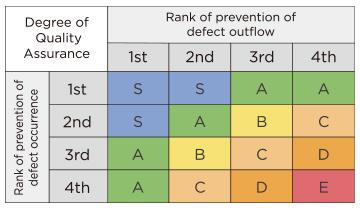
Additionally, to eliminate defects in processes, we promote the introduction of the Degree of Quality Assurance, which is an indicator that visualizes quality risks. With this indicator, the probability levels of the occurrence and outflow of each type of defect are respectively determined on a scale of 1 (suciently prevented) to 4 (not prevented) and combined into a rating on a six-point scale of S to E as shown on the right. To prevent any defect whose occurrence is a concern, we improve quality in pursuit of defect-free process conditions so that the Degree of Quality Assurance for the type of the defect is B or higher. By doing so, we aim to prevent defects from flowing out to customers and also to prevent recurrence of complaints. The Degree of Quality Assurance enables us to assess quality risks objectively and make more eective risk reduction efforts.
2. Enhancement of “Quality Management Education”
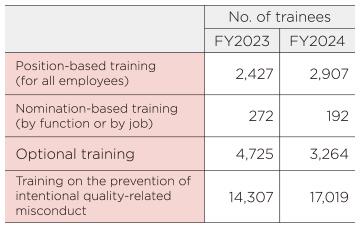
The Group provides employees with training on quality control at the SEI University ensure the quality of products and services at higher levels. We have worked to improve various education programs, such as position-based training for all employees, nomination-based training in accordance with specialized jobs and special issues and optional training to learn relevant knowledge, along with practical education including QR-J*, MKP* and GKP*. Overseas, we have conduct Monozukuri Committee activities by area (4 regions: Americas, Europe & Africa, Southeast Asia & Australia, and Greater China) and organized education and exchange meetings on Own Process Quality Assurance Activities in Asia. Furthermore, supplier training is provided by each division.
*QR-J: “Own Process Quality Assurance practitioner training course” to develop key persons for the Own Process Quality Assurance activities in each division.
*MKP: Abbreviation of “MONOZUKURI-KAKUSHIN professional training Program” that is the practical training program to develop candidates for future plant managers and key personnel for manufacturing.
*GKP: Abbreviation of “GENBA-KAIZEN professional training Program” that is the practical training program to develop key-personnel who are to manage and supervise manufacturing fields and promote shop-floor improvement.
3. Global Quality Management System Audits
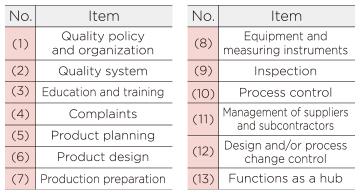
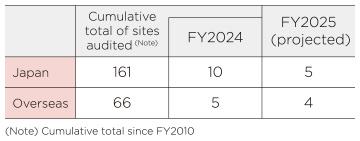
We systematically conduct Global Quality Management System Audits both in Japan and overseas to evaluate the quality control initiatives of each division in light of the Quality Management Global Standards from the perspective of customers. The Global Quality Management System Audits are conducted from the perspectives of management, design, manufacturing, and functions as a hub in line with the 13 items set out in the Sumitomo Electric Group Quality Management Global Standards. These audits not only help each division identify its own weaknesses and launch eorts to improve its quality management structure but also allow us to support each division’s follow-up activities aimed at structural reinforcement. Since the audits were started in fiscal 2010, the quality structure has been improved as the audits are repeated. We will further repeat the audits to promote continuous improvement of the quality management system. Furthermore, our suppliers are also subject to this kind of audit conducted by each relevant division, which approves the suppliers according to the audit results.
4. Trends in the number of complaints received
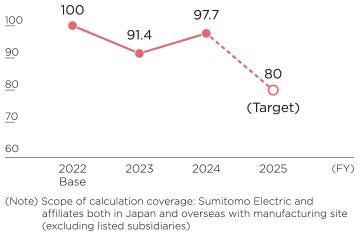
Compared to the base year (FY2022) level defined as 100, the number of complaints for FY2024 was 97.7, a decrease of only 2.3%, in part to an increase in the number of complaints resulting from an increase in the number of new projects. In fiscal 2025, while working to strengthen our ability to launch new projects, we will continue our steady efforts to eliminate complaints with the three main pillars of Own Process Quality Assurance Activities, Quality Management Education, and Global Quality Management System Audits, in addition to Monozukuri Technology improvement activities.
Ensuring Quality Compliance
Complying with laws and rules and providing products that meet customers’ quality requirements is the absolute foundation for our sustainable development as a company. The Group operates globally and complies with local (national) laws and regulations. We also implement the following measures to ensure quality compliance.
<Clarification of rules on the prevention of intentional quality-related misconduct>
The Group has established rules to be followed to prevent intentional misconduct related to quality data and improper inspection and incorporated these rules into the Quality Management Global Standards. In addition, we have added countermeasures against deficiencies in rules that may lead to intentional quality-related misconduct to the items of the annual self-assessment of major business processes. We have also incorporated those measures into training in the prevention of intentional quality-related misconduct to raise employee awareness of them. In fiscal 2022, we organized and consolidated the rules on the prevention of intentional quality-related misconduct, as well as key issues for inspection and system development, to establish and bring into effect new Regulations on Preventing Intentional Quality-related Misconduct. All divisions of the Group have established and are operating systems in accordance with these regulations.
<Improvement of education on the prevention of intentional quality-related misconduct>
The Group provides compliance training for managers. In addition, since fiscal 2023, we have been oering an e-learning program on the prevention of intentional quality-related misconduct to all employees of Group companies in Japan. Overseas, we provide training on compliance (the prevention of intentional quality-related misconduct) for the staff of the quality assurance department and inspection personnel.
<Strengthening of the function of checking intentional quality-related misconduct>
In the Group, the Quality Management Division strengthens inspections related to the prevention of intentional quality-related misconduct as part of Global Quality Management System Audits of each division. The Group also has a mechanism for all divisions to conduct an annual business process self-assessment, where we confirm every year that there is no intentional quality-related misconduct and that each division has in place rules for the prevention of intentional quality-related misconduct and provides quality compliance training with a reliable level of attendance. The fiscal 2024 self-assessment detected minor deficiencies in our internal quality management rules, but we have corrected all of them.
Product Safety
The Group is working to enhance the safety of its products based on the corporate principles of oering the very best goods and services to satisfy customer needs and contributing to creating a better society and environment, with a firm awareness of our social responsibility. We believe that the basis of product safety assurance is thorough examination of the safety of the products we oer to the market, especially at the development and design stages.
<Product safety training>
For product safety, we hold an annual technical seminar on the Product Liability Act and the revised Consumer Product Safety Act for all divisions of the Group. Based on the idea that the safety standards that companies must meet should even anticipate predictable misuse, the training includes case studies to deepen trainees’ understanding of laws and regulations, and also covers practical matters, such as how to review product safety at the development and design stages and how warning signs should be displayed, as well as how to ensure product safety, to collect product safety information and to respond to any accident. In addition, each division creates a database of information on past problems and solutions to them and uses it to educate engineers during divisional training.
<Self-assessment on product safety>
As part of the product safety initiatives, each division and company conducts a self-assessment once every two years against a set of checklists consistent across the Group. Based on these inspections, each division and company identifies product safety risks and independently devises and implements necessary countermeasures, thereby improving its system for promoting product safety measures.
Management of chemical substances in products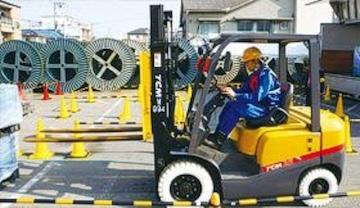
Activities for the Improvement of Logistics Quality
Sumitomo Electric is committed to the improvement of logistics quality in concert with transport companies carrying our products, in order to prevent product damage, fouling and other accidents during transportation and ensure to carry our products to customers without any accidents.
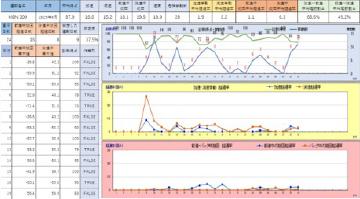
To reduce the occurrence of damages, particularly during the use of forklifts which are prone to product accidents, we continue to implement the "Forklift Basic Operation Compliance Activity," where qualified personnel periodically check and provide guidance on site operations. Additionally, by equipping forklifts with drive recorders that have driving diagnostic functions, we can conduct daily evaluations from the driver's perspective. These measures have yielded certain results in reducing the number of product accident incidents.
Providing Products that Meet Customer Needs: Sales Unit’s Initiatives to Improve Customer Satisfaction
The business activities of the Group consist mainly of business-to-business transactions. Therefore, in our daily sales activities, our sales representatives act as the main point of contact and listen to the opinions and requests of our corporate customers. We believe that accurately understanding the opinions and requests of corporate customers and resolving their problems will lead directly to greater customer satisfaction, which will in turn enhance our corporate purpose.
The key to promoting these activities is to improve the skills of sales representatives. Therefore, we have appointed training staff within the Sales Units in order to continuously enhance the ability of sales staff to understand problems faced by customers and propose appropriate solutions to them. We also work with external consultants to provide sales sta with training in practical methodology and management staff with training on how to manage and instruct their subordinates. In addition, the action guidelines we have established for management sta to stimulate the organization include the improvement of customer satisfaction as a key item. We will continue to strive to improve our sales activities so that our customers will recognize us as their true business partner.