Improvement of the Workplace Environment
Basic Concept
Amid major changes in the social environment, the Group has formulated the Sumitomo Electric Group Policy on Human Rights and issued the Sumitomo Electric Group Health and Productivity Management Declaration in addition to the Global HRM Policy, in order to ensure that diverse human capital can work with a sense of fulfillment and demonstrate their abilities to the fullest extent possible. Through these efforts, the Group strives to create a dynamic workplace that respects human rights and allows diverse human capital to thrive.
Since 2008, the Company has been promoting a Company-wide initiative to realize an even better-balanced work style, while improving its personnel systems, reducing total annual working hours, encouraging employees to take paid leave, and increasing productivity through improved work efficiency.
Currently, the Company is working on initiatives from various perspectives, particularly influencing the corporate culture and employee’s awareness, utilizing infrastructure and IT tools to increase productivity, and reviewing operation rules and processes.
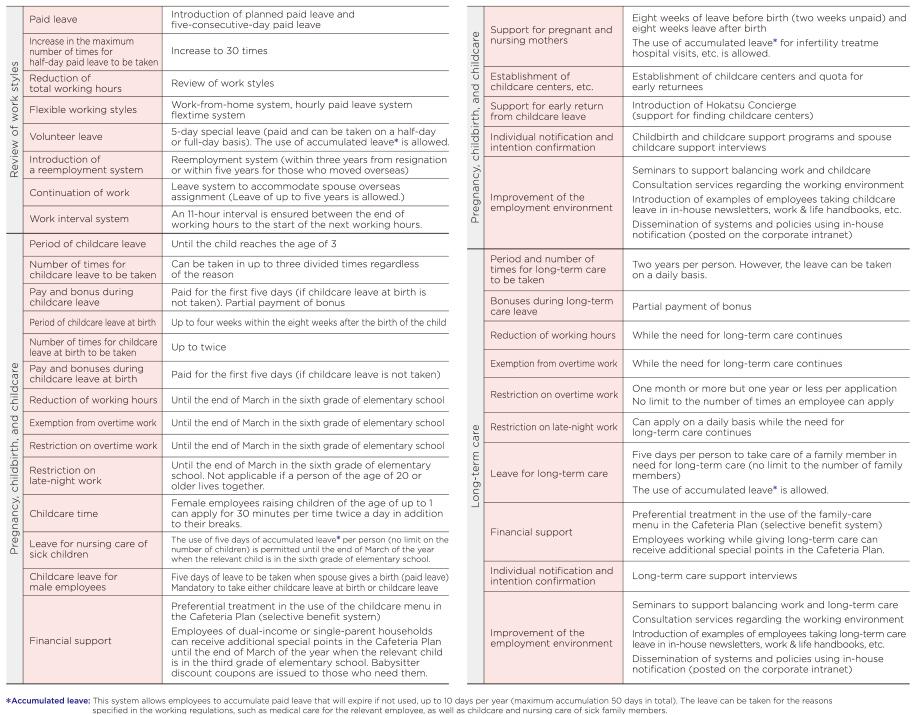
The Company is also improving its systems to meet the diverse needs of its employees to help them balance work with childcare and long-term care.
Structure
To create an environment where diverse human resources can work lively, the union and management have set up expert committees of various kinds to improve working systems and reinforce monitoring functions.
In addition, we regularly organize town hall meetings where employees can have direct dialogue with executives and make use of the opinions received in the meetings for organizational operation and planning of personnel systems.
Discussion Between Labor and Management
Sumitomo Electric believes that the development of a company goes hand-in-hand with the well-being of its workers' union members. On the basis of this belief, Sumitomo Electric strives to address various relevant issues by thorough discussion between labor and management, each party appreciating the other's standpoint.
The Central Management Council Meeting, which is held four times a year, has been organized in its history of more than 70 years.
Representatives of labor and management meet for opinion exchange concerning business environments and managing conditions in this meeting. We have also set up expert committees of various kinds, such as the Working Hour Reduction Expert Committee and the Health and Welfare Expert Committee.
To facilitate adaptation to diverse work styles and create an environment where all employees can work lively with smiles, we are improving various working systems and reinforcing monitoring functions.
System for Listening to Employee Opinion
●Organization of Town Hall Meetings
Town hall meetings are held with the attendance of executives including the President, administrative members and manufacturing site managers. They involve vigorous exchange of opinions on the direction the company should take and problems to be solved, such as how managers should train subordinates and younger employees and how the workplaces should be operated. We also hold informal meetings to create a lively working environment, at which the HR & Administration Department holds dialogues with younger staffs and listens to their voices directly, on personnel issues including the current situation of each workplace regarding work style reforms, the personnel evaluation system and career building. We use these meetings to improve personnel-related measures, deepen young employees' understanding of the personnel system, and enhance motivation.
Targets
Targets to achieve the Mid-term Management Plan 2025
-
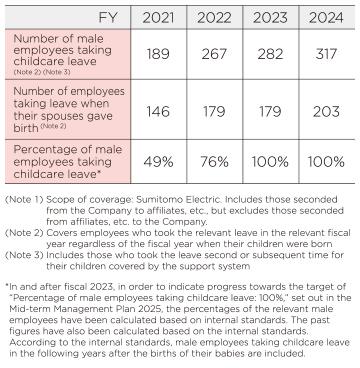
Percentage of male employees taking childcare : 100%
-
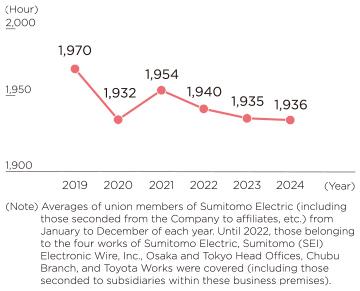
Total working hours : Less than 1,950 hours / year
-
Promote work styles suitable for increasing productivity and producing desired results
Initiatives

■Childbirth and childcare support program
During the period of childbirth and childcare, it is especially important for the relevant employees and their superiors to have detailed “dialogue.” Since fiscal 2015, the Company has institutionalized dialogue between employees and their superiors at the following times: when the relevant employees find out they are pregnant; one month before taking maternity leave; before returning to work from childcare leave; and two months after returning to work from childcare leave.
Since fiscal 2019, a dialogue six months after returning from childcare leave has been added in order to promote dialogue with an eye toward career development. The Company, thus, supports employees in making a smooth return to work and playing an active role after returning from childcare leave.
■Promotion of males’ engagement in childcare
To promote males’ engagement in childcare, the Company has set a Company-wide target of 100% male employees taking childcare leave and requires all the relevant employees to take at least five consecutive days of childcare leave at birth or childcare leave within eight weeks of the birth of their children. In addition, the Company takes various initiatives to create a work environment that makes it easier for employees to take childcare leave, such as spouse childcare support interviews conducted for employees reporting that their spouses have become pregnant or given birth, and a childcare support guidebook released for male employees and supervisors.
personnel support systems
■Childcare center
As part of efforts to establish an environment that helps employees continue to work while raising children, the Company opened childcare centers at the Yokohama and Osaka Works in 2008, at the Itami Works in 2009, and near the Tokyo Head Office in 2018, with 43 children of employees currently enrolled (as of the end of March 2025).
For employees who are unable to use these childcare centers, the Company takes other supportive measures, such as subsidizing the use of other childcare centers.
■Kidsit subsidy
Depending on the age of the child, the Company provides Babysitter Discount Coupons, issued as support by the Agency for Children and Families, free of charge for those who use babysitting services to balance work and childcare, as well as the Company’s own kidsitting fee subsidy.
■Hokatsu Concierge
The activity of hunting for day care (“hokatsu” in Japanese) requires a variety of know-how, as the methods and schedules vary depending on the day care environment in the place of residence and on the month the relevant child was born.
Launched in November 2014 to help employees on childcare leave return smoothly to work at the time of their choice, this system is intended to provide hokatsu know-how tailored to the relevant employee’s circumstances and information on daycare centers.
■Support for balancing work and long-term care
To date, the Company has been working to help employees balance work and long-term care by improving its leave system and increasing the profile of the system at seminars. Since April 2025, the Company has provided further support with consideration given to each employee’s circumstances by, for example, introducing long-term care support interviews between the relevant employees, their supervisors, and human resources staff, and improving the Cafeteria Plan (selective benefit system).
■Work from home
In fiscal 2016, the Company introduced a work-from-home system to allow employees who have certain restrictions on working at the Company’s premises due to their need to provide childcare, long-term care, etc. to work from home. In fiscal 2018, in order to realize more flexible and efficient working styles and increase productivity by reviewing working styles, the Company expanded the scope of the system’s eligibility to include employees who meet certain requirements, such as being able to carry out their work autonomously and produce the desired results. In and after fiscal 2022, the Company relaxed the requirements. With its eye on an increase in productivity and generation of desired results, since fiscal 2022, the Company has allowed employees to work from home at the discretion of their superiors based on the assumption that they work from home about five days per month on average, as long as it does not exceed half of the monthly working days. Even if it exceeds half of the monthly working days, employees can work from home with approval from general managers.
■Reemployment system
Since 2008, the Company has had a reemployment system in place to reemploy former employees who unavoidably resigned due to reasons such as childbirth, childcare, or long-term care. In the system, the Company organizes interviews and reemploys eligible persons when they are able to return to work (within three years from resignation or within five years for those who moved overseas), and in principle, assigns them to their former workplaces.
■Leave system to accommodate spouse overseas assignment
Since 2017, the Company has had a leave system to accommodate spouse overseas assignment, allowing employees to take leave of up to five years to accompany their spouses assigned overseas. The system is intended to prevent such employees from quitting the Company.
■Volunteer leave program
Employees can take up to five days of paid leave per year (up to a maximum of 15 days if accumulated leave is included) to engage in volunteer activities approved by the Company. The program is used for various activities that contribute to regional communities, such as supporting disaster recovery efforts.
Evaluation by External Organizations
■ Certification in the “Platinum Kurumin” System
In the “Platinum Kurumin” system, the Minister of Health, Labour and Welfare of Japan grants certification to companies that are actively committed to supporting employees in child-rearing through an especially high level of initiatives in order to assist the healthy growth of children, who are bearers of the society of the next generation. Sumitomo Electric received the certification in June 2019.